
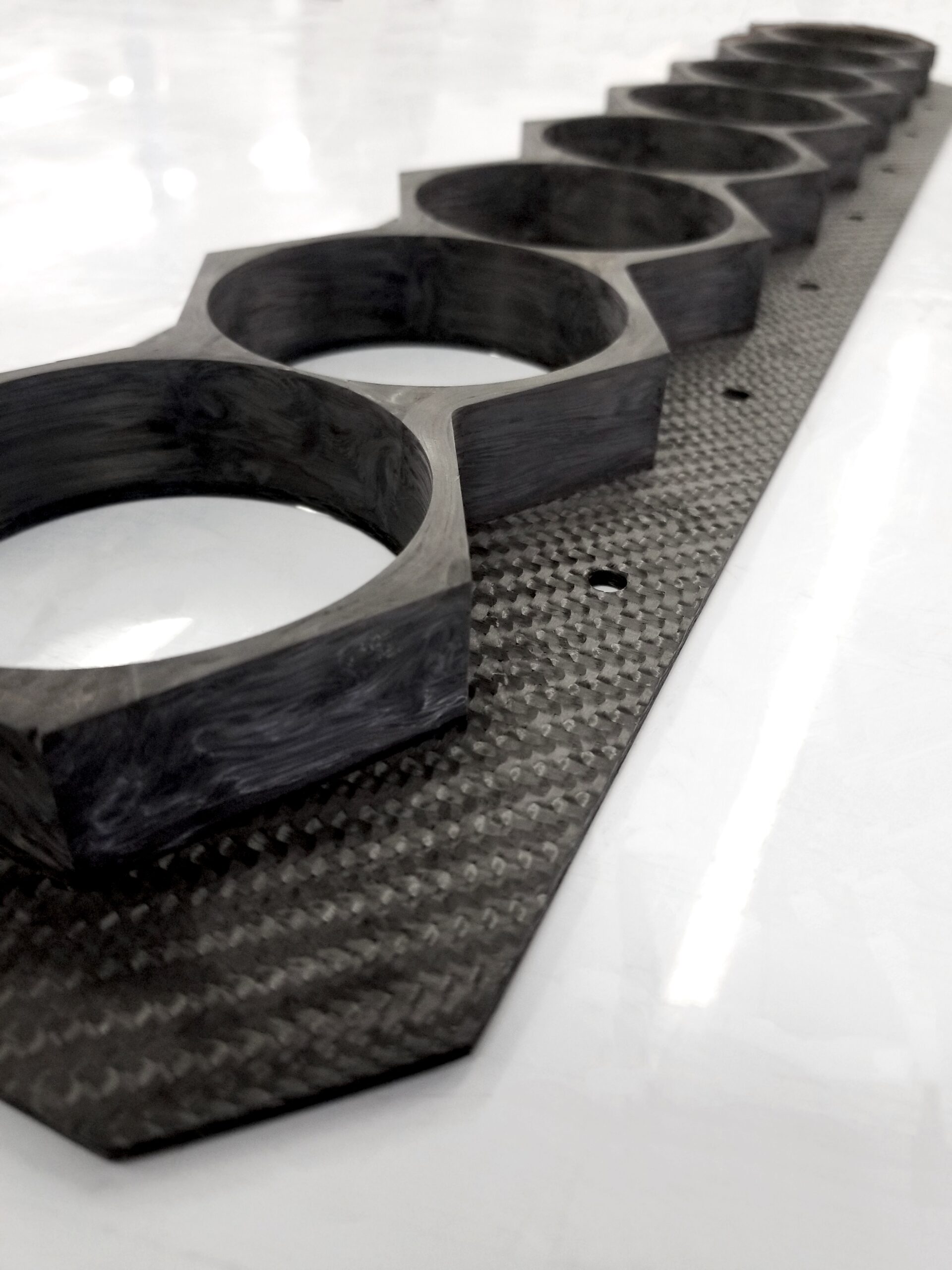
Engineered for strength. Built custom.
Carbon fiber is more than a premium material. It’s an engineered composite solution for components that require a specific balance of strength, stiffness, durability, and low mass.
For product developers, designers, engineers, and purchasing teams, custom carbon fiber parts can offer a high-performance alternative to legacy materials like metals and plastics.
At Southwest Composite Works, we’ll partner with your team to evaluate the structural requirements, operating environments, tolerances, and production volumes of your project before it ever moves into manufacturing.
WHAT IS CARBON FIBER?
CARBON FIBER COMPONENTS
A carbon fiber component is a composite system consisting of two primary elements: carbon fiber reinforcement and a binding polymer resin matrix.
The carbon fibers provide the foundational strength and rigidity, while the resin matrix holds those fibers in place, transfers mechanical loads between them, and helps the finished part maintain its shape.
The final performance of your component depends entirely on intentional engineering decisions you make early on, like fiber orientation, ply schedules, resin selection, tooling architecture, and curing methods.
MATERIAL ARCHITECTURE & ENGINEERING FOR CARBON FIBER PARTS
A successful composite part is designed around how it will carry loads in real use. By controlling the material architecture, the part can be engineered around its intended use case:
A successful composite part is designed around how it will carry loads in real use. By controlling the material architecture, the part can be engineered around its intended use case:
FIBER ORIENTATION:
Aligning the directional strands of carbon parallel to the primary stress paths of the part, to maximize load capacity, while minimizing unnecessary material.
Ply schedule:
Determining the precise number, sequence, and angular orientation of the carbon fiber layers to balance multi-directional forces.
Resin system:
Selecting the matrix material that bonds the fibers, which affects the component's thermal stability, chemical durability, and environmental performance.
THE ADVANTAGES OF CARBON FIBER
While conventional materials have performance limits around weight, deflection, and environmental fatigue, carbon fiber solves geometric and mechanical challenges that other materials cannot resolve as efficiently.
Mass reduction
Significantly lowers part weight compared to many metal alternatives while maintaining strong structural performance—improving efficiency, handling, and user comfort.
Directional stiffness
Composites can be selectively reinforced where rigidity matters most, allowing for minimal deflection under expected loads.
Corrosion & environmental resistance
Carbon fiber accommodates complex contours, variable wall thicknesses, and custom profiles that are difficult or cost-prohibitive to machine from solid metals.
Design flexibility
Composites can be selectively reinforced where rigidity matters most, allowing for minimal deflection under expected loads.
COMPARING CARBON FIBER TO TRADITIONAL MATERIALS
Material selection should always be dictated by a part’s function, load requirements, operating environment, production volume, and budget targets. Carbon fiber can offer meaningful advantages when traditional materials create problems around weight, stiffness, corrosion, geometry, or long-term performance:
| Traditional Material | Why Carbon Fiber Is a Better Choice | When to Consider Carbon Fiber |
|---|---|---|
Aluminum | Lower weight, high stiffness-to-weight performance, and easier support for complex contours | When weight reduction, complex geometry, or part consolidation matters |
Steel | Significant weight reduction, corrosion resistance, and easier handling when engineered for the load case | When a steel part is too heavy, difficult to handle, or exposed to corrosive conditions |
Plastic | Greater stiffness, strength, dimensional stability, and long-term structural performance | When plastic flexes, deforms, wears, or lacks the rigidity the application requires |
Fiberglass | Lower weight, higher stiffness, sharper appearance, and more performance-oriented laminate design | When stiffness-to-weight ratio, finished appearance, or performance feel matters more than lowest cost |
These are starting points as you consider carbon fiber, and not automatic rules. The right material for a project always depends on how the finished part will actually be used.
IS CARBON FIBER THE RIGHT FIT FOR YOUR PROJECT?
As you consider composite parts, keep in mind that carbon fiber may be a strong material choice when your part needs one or more of the following:
- A high strength-to-weight ratio
- A high stiffness-to-weight ratio
- Lower weight than a metal part
- Better rigidity than many plastic or fiberglass parts
- A custom shape, contour, or profile
- Durable performance in demanding use conditions
- Resistance to corrosion or environmental exposure
- A clean, high-performance appearance
- Repeatable production from prototype to finished part
Carbon fiber can also help when an existing metal assembly is too heavy, too complex, or too inefficient to produce as separate components. In some cases, a composite design can consolidate multiple pieces into a lighter, stronger, and more functional part.
That is why we help evaluate manufacturability early. By reviewing your part’s function, load requirements, operating environment, tolerances, geometry, and production goals, we can help determine whether carbon fiber is the right material for your part.
WHY CHOOSE SOUTHWEST COMPOSITES AS YOUR PARTNER
Carbon fiber part performance depends on how the part is designed, tooled, laid up, cured, machined, inspected, and prepared for repeatable production. At Southwest Composite Works, our team brings each of those disciplines together, which makes us uniquely positioned to support your company’s carbon fiber project:
Proven composite manufacturing experience
Southwest Composite Works has completed 1,700+ projects, brings 100+ combined years of experience, and has served customers across 10+ industries since its roots in 1994.
Design support before production begins
Our team reviews your part’s function, loads, tolerances, materials, schedule, cost targets, and manufacturability before you commit to tooling or production.
Concept-to-production capabilities under one roof
We support carbon fiber projects through design, prototyping, tooling, molding, machining, finishing, inspection, and production planning. alloys and carbon fiber.
Built for demanding applications
We manufacture custom composite parts for aerospace, medical, recreation, industrial, machining, and other applications where strength, weight, durability, and repeatability matter.
Practical material-fit guidance
Carbon fiber is not the right answer for every part. We help evaluate whether the best path is carbon fiber, a revised design, a different manufacturing process, or another material.
OUR WORKFLOW
At Southwest Composite Works, we support custom carbon fiber projects through a coordinated, end-to-end workflow that’s designed to help teams move from early concept, sample, or CAD model, all the way to finished parts.
Design and manufacturability review
We evaluate early concepts, sketches, physical samples, legacy parts, or completed 3D CAD models to determine how a part should be designed for carbon fiber manufacturing.
Prototyping
We develop prototypes with the final manufacturing method in mind, helping your team validate fit, form, function, manufacturability, and material performance.
Tooling and molds
Our team designs and builds the master patterns, molds, fixtures, and tooling needed to support your carbon fiber project’s dimensional accuracy, surface finish, and repeatability.
Layup and molding
We build parts layer by layer, placing carbon fiber material into the tooling, and aligning the laminate structure with the part’s expected stresses and geometry.
Controlled curing
Our team matches the right curing process with your part’s needs, using methods such as vacuum bag molding, compression molding, vacuum bag molding, oven curing, autoclave molding, or bladder molding.
Machining and secondary operations
After curing, many carbon fiber parts require trimming, drilling, edge finishing, feature machining, bonding, inserts, or hardware integration.
Inspection and quality control
Before delivery, we review your finished carbon fiber component for dimensional accuracy, surface quality, structural integrity, and application-specific requirements.
PARTNER WITH US ON YOUR CARBON FIBER PROJECT
Whether you have a fully dimensioned 3D model, a physical sample, a sketch, a legacy metal part, or an early-stage concept, we can help you determine the right next step.
Tell us what the part needs to do, where it will be used, what requirements it must meet, and what production volume you are planning for. We can help evaluate the material, review manufacturability, recommend a process, and move your project toward a finished custom carbon fiber part.