
Repeatable carbon fiber production for low-to-mid volume programs.
We manufacture carbon fiber components using compression molding when repeatability, controlled tolerances, and production efficiency are critical to your project’s success.
Compression molding allows you to produce structurally consistent composite parts with durable matched tooling, efficient cycle times, and reduced labor variability. It is particularly well suited for low-to-mid volume production where predictable cost-per-part, dimensional stability, and long tooling life are vital.
Our team evaluates your part’s geometry, tolerance requirements, performance criteria, and volume targets before tooling begins, ensuring compression molding is engineered for real-world production processes.
LET'S TALK ABOUT YOUR COMPANY'S PROJECT
Built Better, By Design.
COMPRESSION MOLDING AT SOUTHWEST COMPOSITE WORKS
At Southwest Composite Works, we engineer custom molds, material selection, and press parameters together to support repeatable production and consistent dimensional control across the lifetime of your program.
Our engineering and manufacturing teams operate under one roof, so any tooling decisions are made with full awareness of downstream trimming, machining, inspection, and assembly requirements.
That means we can help you to reduce rework, stabilize tolerances, and improve your schedule predictability.
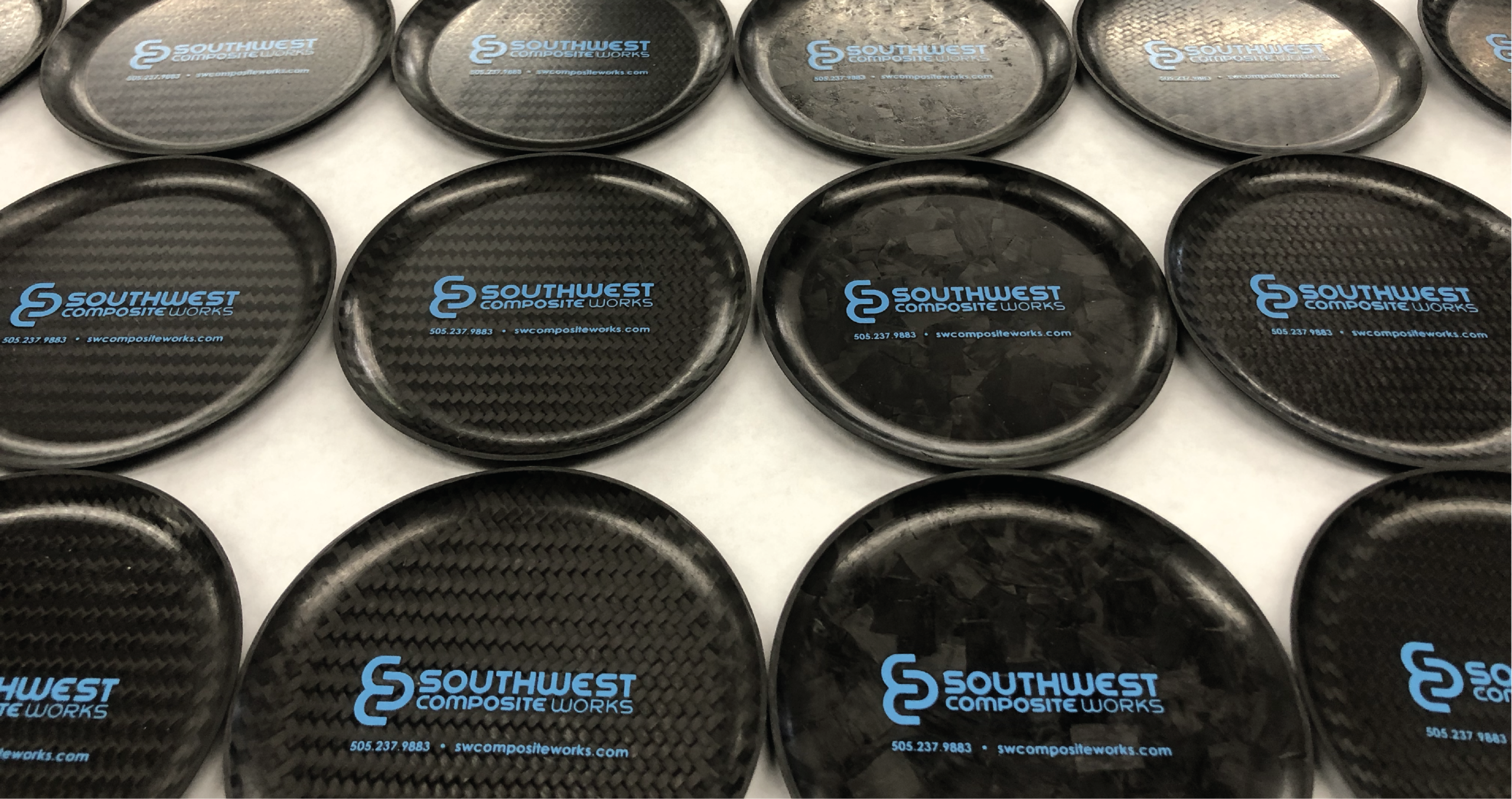
We design compression molding programs to help you:
- Maintain controlled part thickness and dimensional repeatability through matched tooling
- Support low-to-mid volume production with consistent output
- Reduce variability compared to labor-intensive layup processes
- Extend mold life through durable tooling design
- Improve lifecycle program economics with stable cycle efficiency and careful material utilization
Application and Production MATCH
WHEN COMPRESSION MOLDING IS THE RIGHT FIT
If your project prioritizes predictable production economics, tooling durability, dimensional consistency, and long-term cost stability, compression molding may be a good choice for your project.
Compression molding is typically well suited for:
- Parts requiring consistent geometry and controlled tolerances
- Programs where labor variability must be minimized
- Components with relatively uniform wall thickness
- Applications that benefit from durable matched tooling
- Low-to-mid volume production where repeatable cycle time improves cost control
Compression molding may be preferable to hand layup when repeatability and throughput are important, and it may also offer lower labor intensity than more complex closed-mold processes, when appropriate for geometry and thickness.
LET US KNOW MORE ABOUT YOUR COMPRESSION MOLDING PROGRAM
OUR PROCESS FOR COMPRESSION MOLDING
1. Tooling & Mold Engineering
Compression molding begins with tooling designed for structural stability, dimensional accuracy, and repeatability.
We engineer matched molds around your part geometry, expected production volume, tolerance requirements, and material behavior, to maintain consistent thickness and part-to-part dimensional control.
Outcome: We can make tooling decisions with downstream machining, assembly fit, and inspection criteria in mind, helping to stabilize tolerances and reduce secondary rework.
2. Material System Evaluation
We evaluate composite material systems based on structural performance, thermal exposure, environmental conditions, and production efficiency. Material selection directly affects consolidation behavior, surface finish, dimensional stability, and cycle consistency.
Outcome: By aligning your material choice with tooling and press parameters, we can reduce variability, and improve repeatability across production runs.
3. Controlled Pressing & Consolidation
Our compression molding process applies calibrated pressure and temperature profiles to consolidate composite material within matched tooling. Process discipline is essential to maintaining fiber integrity, thickness control, and structural consistency from part to part.
Outcome: We can monitor and control key parameters to support consistent outcomes across repeating cycles.
4. Finishing, Machining & Inspection
After molding, parts move through controlled trimming and machining operations to meet final dimensional and assembly requirements. Each component is inspected against defined specifications to verify dimensional accuracy and conformance before shipment.
Outcome: We can ensure any secondary operations remain predictable, controlled, and aligned with your quality requirements.
GET IN TOUCH TO TELL US ABOUT YOUR COMPANY'S PROJECT
WHAT YOU CAN EXPECT FROM COMPRESSION MOLDING AT SOUTHWEST COMPOSITE WORKS
Integrated Engineering And Production
Design, tooling, molding, machining, and inspection are managed in-house. This integration reduces communication gaps and aligns manufacturing decisions with performance goals and quality standards.
Tooling Engineered For Durability And Tolerance Stability
Matched molds are built for production use, supporting consistent geometry, maintained tolerances, and extended service life across repeated cycles.
Production Stability For Lifecycle Cost-Control
We evaluate cycle time, material utilization, tooling durability, and secondary operations to help stabilize cost-per-part over the full life of your program.
US-Based Manufacturing Oversight
All compression molding work is performed in the United States, supporting great quality control, schedule reliability, and direct communication throughout your project.
READY TO DISCUSS YOUR COMPRESSION MOLDING PROGRAM? TELL US MORE