
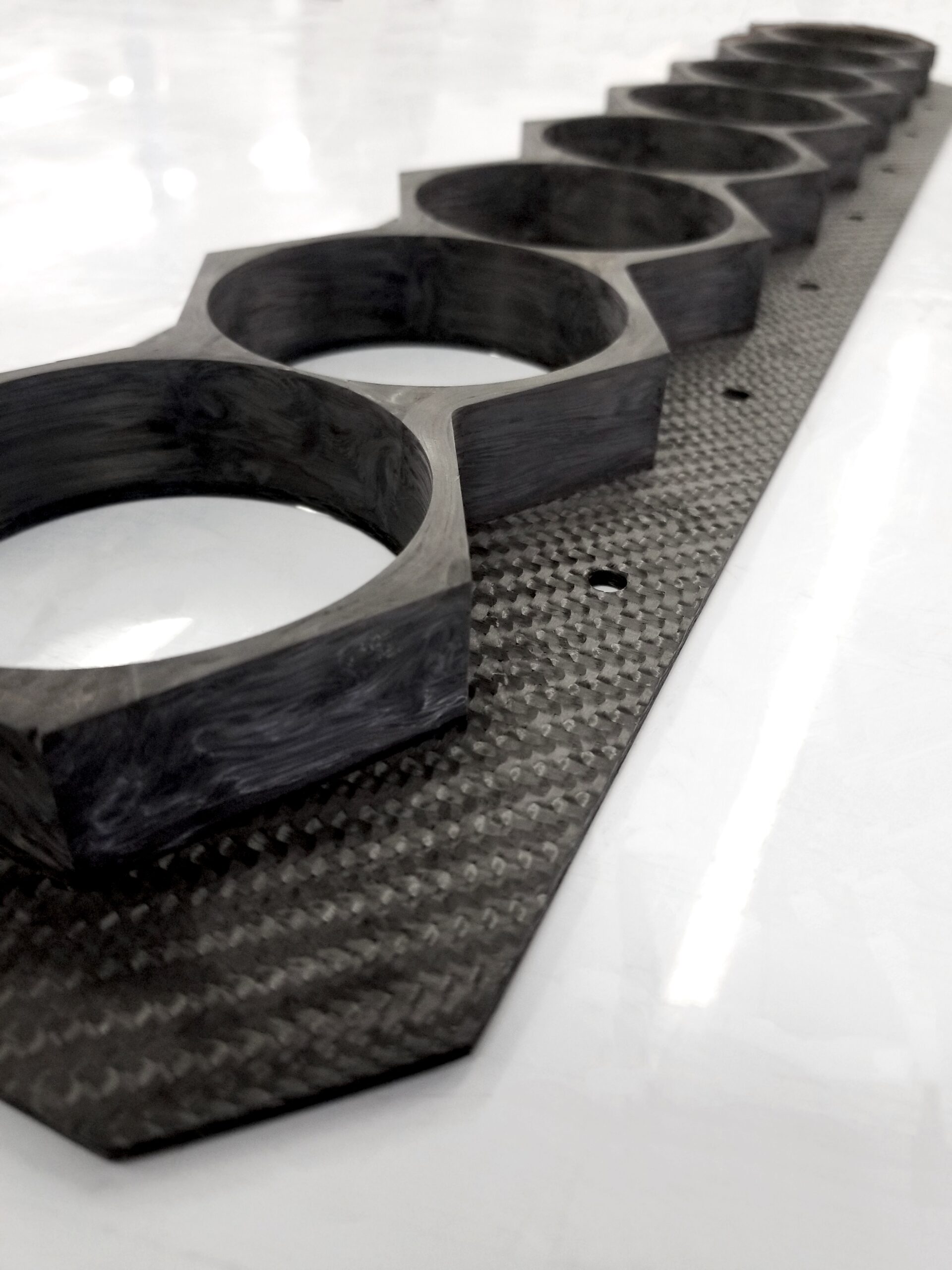
You name it and it can be made from carbon fiber!
Lightweight. Durable. Carbon fiber is a low-density material with a very high strength-to-weight ratio. This means that carbon fiber is incredibly tough and light, five times stronger than steel and 43% lighter than aluminum, making it perfect for manufacturing applications.
At the core of carbon fiber, and its praised properties, is its unique structure: carbon atoms are bonded together to form crystals that are then aligned parallel to the long axis of the organic fiber. Mimicking that of yarn, these fibers are made up of thousands of extremely thin carbon strands that are interwoven together. This unique composition and production largely contribute to its indispensable properties!
From lightweight versatility to durability, energy absorption, and sleek appearance, carbon fiber offers numerous manufacturing benefits and is ideal for virtually anything.
what is it?
COMPOSITES
A composite is a material made by combining two or more distinct materials with different properties, typically a reinforcing fiber and a binding matrix. This combination creates a material that is stronger, lighter, and more durable than its individual components.
To produce composite parts, carbon fiber fabric is saturated or infused with epoxy resin and cured under heat and pressure. For shaped components, multiple layers of fabric are precisely laid over a mold, infused with resin, and heated until the resin fully bonds through all layers. The result is a high-performance structure engineered for strength, precision, and reliability.
custom carbon fiber parts
ADVANTAGES OF CARBON FIBER
4X The Strength of Steel
Strength-to-weight ratio:
Carbon fiber is stronger than steel when comparing strength per unit of weight.
Tensile strength:
Carbon fiber can have a tensile strength of up to 6,000 MPa, while steel's tensile strength ranges from 400 to 1,200 MPa.
5X Lighter Than Steel
Density:
Carbon fiber has a density of around 1.6g/cm³ while steel has a density of around 7.85 g/cm³.
Applications:
Extremely beneficial in applications where weight reduction is crucial, like aerospace, UAV, lightweight outdoor gear, high-performance vehicles, and much more.
3X Stiffer Than Aluminum
Density:
Carbon fiber has a density of around 1.6g/cm³ while steel has a density of around 7.85 g/cm³.
Applications:
Extremely beneficial in applications where weight reduction is crucial, like aerospace, UAV, lightweight outdoor gear, high-performance vehicles, and much more.
High Fatigue and Corrosion Resistance
High fatigue resistance:
Carbon fiber composites can withstand repeated loading and unloading cycles without experiencing significant damage, making them ideal for applications with cyclic loading or vibration.
The fiber orientation of carbon fibers within the composite significantly affects its fatigue resistance.
Corrosion resistant:
Due to its inherent chemical composition, carbon fiber is highly resistant to corrosion and does not rust like metals, making it suitable for outdoor use.
Application:
This combination of properties allows carbon fiber to be used in various applications like aerospace, automotive parts, sports equipment, and structural components where both strength and resistance to environmental factors are crucial.
WHAT CAN BE MANUFACTURED WITH CARBON FIBER?
COMPLEX CUSTOM PARTS
BACKPACK FRAMES & STAYS
AEROSPACE DUCTING
ANKLE FOOT ORTHOTICS (AFOS)
SPORTS EQUIPMENT
MEDICAL ACCESSORIES
ROBOTICS APPLICATIONS
DRONES & UAVS
BICYCLE FRAMES & ACCESSORIES
WIND & SOLAR ENERGY ACCESSORIES
ELECTRONICS ENCLOSURES
AND MORE
Advanced materials. Better results.
LEARN MORE ABOUT COMPOSITES
Lamborghini "Forged Composite" Technology
Learn more about the development of suspension control arms and cost/cycle time reduction with respect to forged composite.
Thermoplastic Composite
Learn more about the features, performance, and benefits of thermoplastic composite.
What is a Forged Composite?
Learn about the advantages of forged composite and its potential useful applications.
Rod And Aluminum Alloys With Carbon Fiber
Read a 2014 analysis of connecting rod with aluminum alloys and carbon fiber.
CARBON FIBER PROPERTIES AND COMPRESSION MOLDING
Molding the future with carbon fiber composites.
START YOUR PROJECT TODAY
or Give Us a Call: 505-237-9883